Dear [firstname],
As I’m sure many of you know, the federal government entered into a partial shutdown on February 14th. I wanted to send this newsletter to give you an update on where things stand, and what got us to this point. |
At midnight on February 14th, funding for the Department of Homeland Security expired. Each year, Congress must pass 12 appropriations bills to fully fund the government—one of our most important jobs. These appropriations bills provide funding for various government agencies and programs for the upcoming fiscal year. As a member of the House Appropriations Committee, I've worked to advance all 12 bills out of the House of Representatives. After that, they must be passed by the Senate and signed into law by the president. If Congress doesn't pass all 12 bills before the end of the fiscal year, we can pass a short-term funding extension called a Continuing Resolution (CR) to keep the government open. A CR gives Congress more time to find an agreement between the House, Senate, and White House on funding levels. On February 3rd, Congress passed a short-term CR to keep the Department of Homeland Security (DHS) funded through February 13th. For the government to avoid a partial shutdown, the Senate needed to come to an agreement on a final DHS spending bill. Unfortunately, an agreement was not reached in time and the government entered a partial shutdown. The Department of Homeland Security is responsible for keeping our nation safe, and that mission extends far beyond immigration enforcement. The DHS Appropriations Act funds disaster response, port security, aviation safety, and counterterrorism efforts, and shutting down the government over one component of the agency's operations creates uncertainty for the millions of Americans who rely on these essential services. I don't support using a government shutdown as a negotiating tactic and remain hopeful we can reach a reasonable compromise quickly so the hardworking men and women of DHS can continue their critical work without major disruptions. During this time, my district and Washington, D.C. offices remain open to assist you or answer any questions you may have. If you’ve submitted casework or need help with a government agency, my district staff is available to help. I understand that many people find this situation frustrating—I do too. As Congress continues to work toward a solution, I’ll continue keeping you updated.
|
Many people have reached out to my office asking how a government shutdown could impact them directly. The Department of Homeland Security includes numerous agencies, including the Transportation Security Administration (TSA), U.S. Coast Guard, Federal Emergency Management Agency (FEMA), Cybersecurity and Infrastructure Security Agency (CISA), Office of Intelligence and Analysis, U.S. Customs and Border Protection (CBP), U.S. Customs and Immigration Enforcement (ICE), U.S. Citizenship and Immigration Services (USCIS), U.S. Secret Service, and Federal Law Enforcement Training Centers. These agencies all play a role in our national security, and while many are still operational, they are working at a limited capacity due to the funding lapse.
According to DHS guidance, only "exempt" activities like law enforcement and maritime protection would continue during a government shutdown, while many administrative, support, and oversight functions would pause. If the shutdown drags on we could see disruptions in immigration processing, disaster relief coordination, cybersecurity support, and air travel.
|
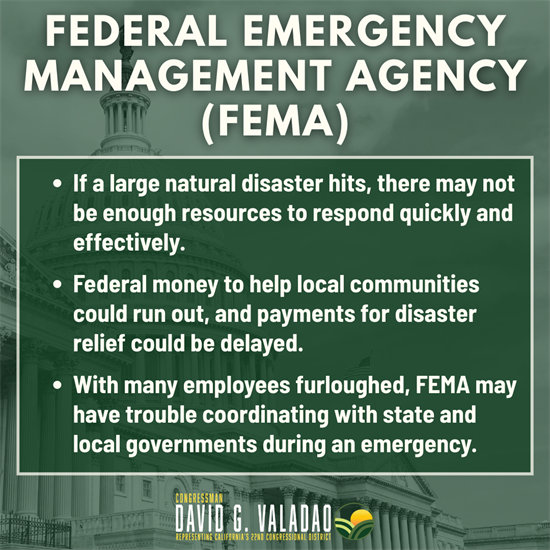
During a DHS shutdown, FEMA would still be able to respond to immediate, life-threatening emergencies by drawing from its Disaster Relief Fund. But a shutdown could still create some challenges. Even if there's resources in the Disaster Relief Fund, fewer FEMA staff on the job means slower coordination and payment processing. When Tulare Lake flooded in 2023, thousands of acres of farmland were underwater and families were forced from their homes. During that time, FEMA worked alongside our local and state partners to support response efforts and begin the long recovery process. That assistance matters in communities where resources are already stretched thin, and in a major natural disaster, any kind of slowdown can make an already difficult situation worse.
|
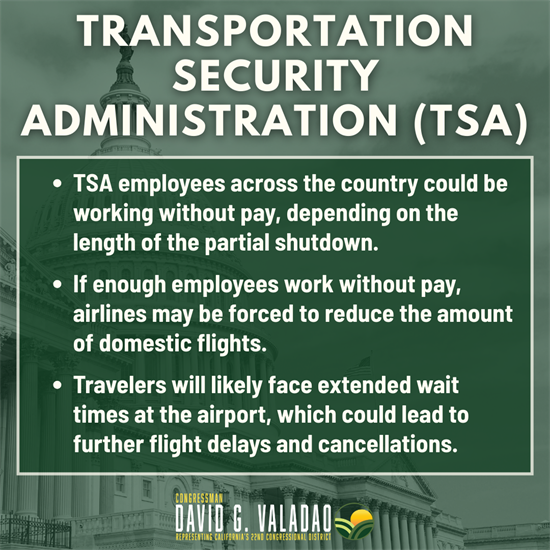
During a DHS shutdown, airport security screening would still continue because most TSA employees are deemed essential. But this means employees are working long hours without pay. Requiring TSA employees to work unpaid raises the risk of unscheduled absences, which can quickly strain staffing levels. Even a small number of call-outs can have substantial effects—especially at smaller airports like Bakersfield Municipal Airport—leading to longer lines and extended wait times. If staffing shortages slow passenger screenings, airlines may choose to delay or even cancel departures until normal operations restart.
|
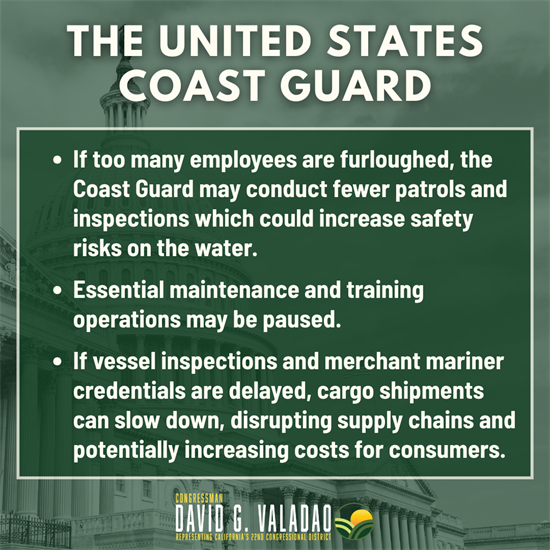
More than 41,000 active-duty Coast Guard members would be required to continue working without pay, while roughly two-thirds of the civilian workforce would be furloughed and prohibited from working. Training for pilots, aircrews, and boat crews would be suspended, and routine maintenance would be deferred, creating a backlog of repairs. The Coast Guard could also scale back routine safety patrols and commercial vessel inspections. If inspections are delayed, consumers could potentially see supply chain disruptions and rising prices, costing the U.S. economy billions.
|
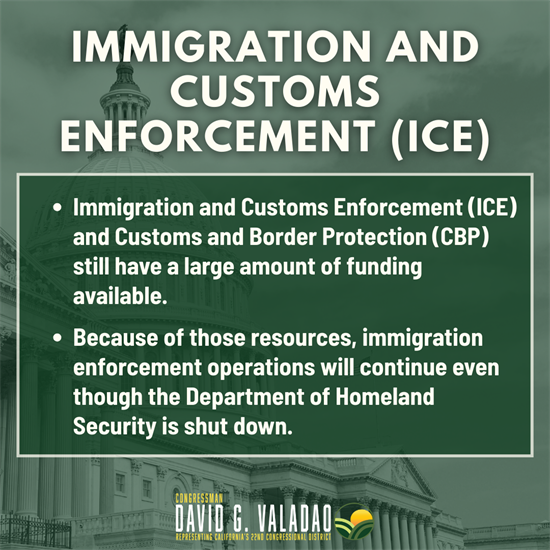
Immigrations and Customs Enforcement and Customs and Border Protection are already funded for the next few years, so both agencies will maintain normal operations during a funding lapse. I've spoken to many constituents who have expressed concern about immigration enforcement operations, and while I support enforcing our nation's laws, I believe all federal agents must be properly trained and adhere to appropriate procedures to retain public trust and keep people safe. I remain supportive of responsible policies that prioritize enforcement against known criminals while also advocating for comprehensive immigration reform. The government funding process always includes bipartisan negotiations, and I'm hopeful we can reach a compromise to reopen DHS soon.
|
Team Valadao started the week by attending the Liberty Tree Planting Ceremony hosted by the Yosemite Chapter of the Sons of the American Revolution, celebrating the 250th anniversary of the Revolutionary War and planting the first commemorative Liberty Tree in California. My staff also met with Kern Community College District Chancellor Bloomberg, to discuss new healthcare and public safety projects. Later, they attended the Kern County Hispanic Chamber of Commerce Government Relations Committee meeting, where they heard from Kern Council of Governments Executive Director Jay Schlosser and Kern Taxpayers Association President Michael Turnipseed.
On Tuesday, the team met with the Kings County Board of Supervisors and newly appointed Kings County Deputy Public Guardian/Veterans Services Officer Codi Pennington, followed by a meeting with Hanford Joint Union High School District Superintendent Dr. Victor Rosa. Staff also attended the Kern County Department of Human Services’ Annual Safely Surrendered Baby Month Press Conference to raise awareness about the Safe Surrender law and its life-saving impact in our community.
On Wednesday, Team Valadao met with the Water Blueprint Board to discuss water solutions for our region. Later, they attended the Shafter Collaborative meeting to hear from local leaders, Kern County Family Justice Center, and the Youth 2 Leaders organization. The team also presented Certificates of Recognition to English language learner students at Richland Junior High School and Golden Oak Elementary as they were reclassified as English proficient.
Later, Team Valadao joined Golden Empire Affordable Housing Inc. at their 4th Street Senior Apartments ribbon cutting ceremony in Bakersfield. My staff presented a Certificate of Recognition and celebrated the $7.5 million in Community Project Funding our office was able to secure for their Bakersfield Senior Center Housing Project. My team also joined the Friant Water Authority Board of Directors at their monthly meeting and attended the Tri County Water Authority Board of Directors meeting to hear about their upcoming plans. They also visited the Greenfield Union School District Nutrition site to meet with Director Josh Rogers and learn more about student nutrition services.
To wrap up the week, the team met with Catholic Charities of Bakersfield Site Director Beatriz Trevino to discuss upcoming projects, provided a legislative update to Cirugia Sin Fronteras (CSF Surgery), and attended the Tulare County Office of Education Expansion groundbreaking ceremony for the Mooney Administrative Campus in Visalia. Later, they attended Cal State Bakersfield's 2026 Engineers Day, which encourages local high schoolers to pursue careers in engineering. Staff also met with Greenfield Union School District Superintendent Ramon Hendrix for district updates and proudly presented a Certificate of Recognition to a 100-year-old VFW veteran during a visit with the Hanford VFW Quartermaster.
|
Trying to get an answer from a federal agency can often be a time-consuming and frustrating process. If you ever need help navigating a federal agency, you can visit my website here or call my Hanford office at (559) 460-6070. My team is ready to assist you!
Tratar de obtener una respuesta de una agencia federal a menudo puede ser un proceso frustrante y que requiere mucho tiempo. Si alguna vez necesita ayuda con una agencia federal, puede visitar mi sitio de web aquí o llamar a mi oficina de Hanford al (559) 460-6070. ¡Mi equipo está listo para ayudarte!
|
Do you have a question about my position on an issue? How the Congress operates? My thoughts on the news of the day? Send your first name, town, and question to AskDavid@mail.house.gov and I might answer yours right here in one of my weekly newsletters. Make sure to subscribe to my weekly email updates to see if your question was answered! If you want to share your opinion with me on issues of importance, you can always contact me on my website. |
Did you know you can now sign up for texts from my office to stay up to date on my work in Washington D.C.? To sign up to receive updates from me directly to your phone, just text VALADAO to (559) 387-4346 and you will be automatically subscribed. You can also sign up for text alerts using this form here. |
ANCA Central California Hosts Talks with Armenian Caucus Co-Chair Valadao
“Congressman Valadao has been a pillar of strength for the Armenian-American community for well over a decade,” said ANCA Western Region Chairman Oshin Harootoonian. “His principled leadership, from championing life-saving aid for Artsakh to standing firm on Armenian Genocide recognition, reflects exactly the kind of commitment our community deserves in Congress. We look forward to working together to defend Armenia’s security, secure Baku’s release of Armenian prisoners, and deliver justice for Artsakh.”
Read more
|
|
Valadao introduces bill to protect Sikh Americans from rising hate crimes and discrimination
Local Congressman David Valadao has introduced bipartisan legislation to protect Sikh Americans from rising hate crimes and discrimination across the country. The Hanford Republican's Sikh American Anti-Discrimination Act directs the U.S. Attorney General to establish a dedicated Department of Justice task force to formally define, track and address anti-Sikh hate crimes.
Read more
|
|
I'll be using this newsletter as a way to keep you updated on my work in Congress. Make sure to sign up for regular updates and follow my Facebook, Twitter, and Instagram to keep up with my work. |
|
|
|
|
David G.Valadao Member of Congress |
|
|